INTRODUCTION TO THE MINISTRY OF WATER BAPTISM
The Origin and Purpose of Water Baptism
Few biblical subjects have generated as much discussion, misunderstanding, and doctrinal confusion as water baptism. Throughout history, believers have wrestled with important questions such as: Is water baptism necessary for salvation? Does being baptized in water mean a person has been born again? These questions deserve more than assumptions or denominational traditions, they deserve clear, biblical answers.While many sincere believers assume the two are identical, the Scriptures present a much deeper and more profound understanding of the subject.
Before we can determine whether being baptized in water is the same as being born again, we must first understand the ministry of water baptism itself. However, before discovering its purpose, we must first discover its origin, because ignorance of origin inevitably produces ignorance of its purpose. Every institution, practice, or ordinance can only be properly understood when viewed from the perspective of why it was first established. Until its origin is understood, its true meaning will always remain vulnerable to misunderstanding.
For this reason, our study begins by asking who introduced water baptism, why it was introduced, and what purpose it originally served. Only after answering these foundational questions can we correctly understand the place of water baptism in God’s redemptive plan.
Lesson Objectives

At the end of this lesson, you should be able to:
-
Explain the biblical origin of water baptism.
-
Identify the individual through whom water baptism became widely practiced.
-
Understand the primary purpose of the ministry of water baptism..
-
Recognize that water baptism was symbolic and preparatory in God's redemptive plan.
-
Appreciate why Jesus submitted to John's baptism, while understanding that its full significance will be explored in the next lesson.
1. Understanding the Importance of Origins
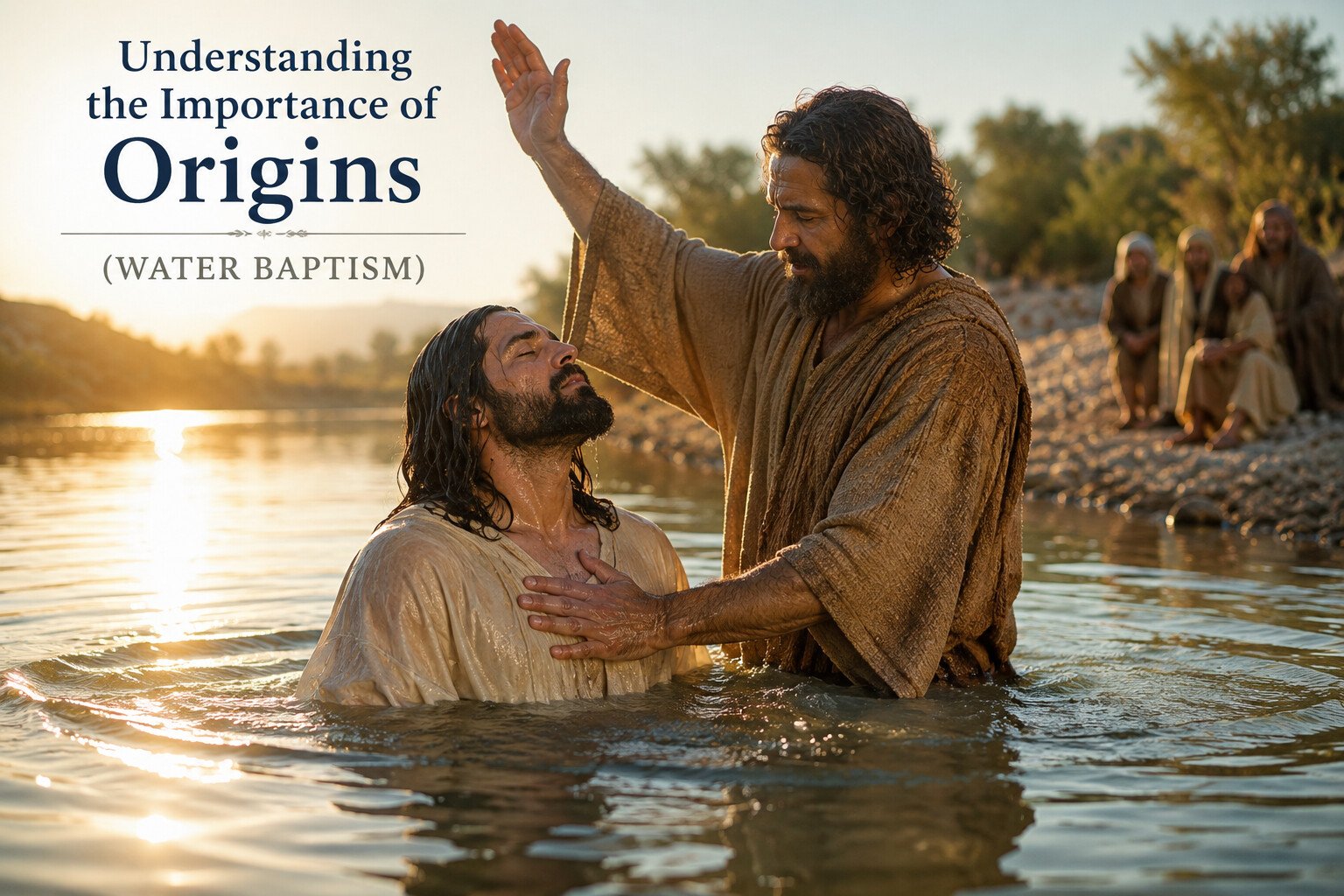
This verse reveals a profound principle: true understanding, value, and power are often discovered by returning to the original source. God instructed His people not to create new paths according to human ideas, but to seek, examine, and follow the “old paths” the divinely established foundations that had already been proven to be good. The phrase “old paths” does not merely refer to ancient traditions; it points to the foundational principles and God-ordained patterns established from the beginning.
Every meaningful action begins with a purpose, and every purpose originates from an intention. Actions are motivated by intentions, and intentions are often motivated by identity. The phrase “ask for the old paths” in Jeremiah 6:16, suggests intentional inquiry, careful study, and a sincere desire to understand origins.
Understanding origins is indispensable because purpose always follows origin. When the origin of a practice is ignored, its purpose is easily misunderstood. This principle is true in every field of knowledge and is equally true in biblical doctrine.
"When the purpose of a thing is not known, abuse is inevitable."
Every meaningful discovery begins with one fundamental question: Where did it come from? Before we can correctly understand, appreciate, or use anything, we must first understand its origin. Origin is the foundation upon which purpose, function, and value are built. To ignore origins is to invite misunderstanding, confusion, and misuse.
Dr. Myles Munroe consistently taught that purpose is only discovered by consulting the source or manufacturer of a thing. Just as an inventor alone fully understands the design and intended function of his invention, so the Creator alone reveals the true purpose of His creation. Therefore, to understand anything accurately, we must first return to its beginning. In Matthew 19:8, Jesus corrected misunderstanding by pointing people back to God's original intention.
"...But from the beginning it was not so." Matthew 19:8
A simple illustration demonstrates this truth. Imagine discovering a sophisticated medical instrument without any instructions or knowledge of its designer. One person might use it as a decoration, another as a toy, and another may even destroy it while experimenting with it. None of these actions reflects the instrument's intended purpose because its origin and design are unknown. Ignorance of purpose inevitably results in misuse.
This principle extends far beyond physical objects. It applies equally to institutions, relationships, principles, and the teachings of Scripture. Whenever humanity loses sight of the original design, counterfeit interpretations and practices emerge. History repeatedly demonstrates that departing from the original blueprint produces confusion, conflict, and corruption.
Studying origins provides four indispensable benefits:
-
It reveals purpose. Knowing where something came from explains why it exists.
-
It establishes correct function. The original design determines the proper way to use it.
-
It protects against error and abuse. Understanding the Creator's intention prevents distortion and misuse.
-
It restores authenticity. Returning to the beginning helps distinguish the genuine from later additions and traditions.
Dr. Munroe often illustrated this to a manufactured product. If someone purchases a new device, they consult the manufacturer's manual,not public opinion to learn how it should operate. Likewise, God reveals His purposes by beginning with the origin. Understanding God's work starts with understanding His beginning and plan.
This truth is especially significant when studying biblical doctrines. Every doctrine has an origin established by God. As generations pass, traditions, customs, and human interpretations may accumulate around the original teaching. While some traditions may be helpful, they must never replace the original intent of Scripture. The safest path is always to return to the source.
The Berean believers demonstrated this noble approach. Rather than accepting teachings blindly, they continually examined the Scriptures to verify whether what they heard aligned with God's original revelation.
Consequently, before asking what water baptism accomplishes, we must first ask who introduced it.
2. Who Introduced Water Baptism?
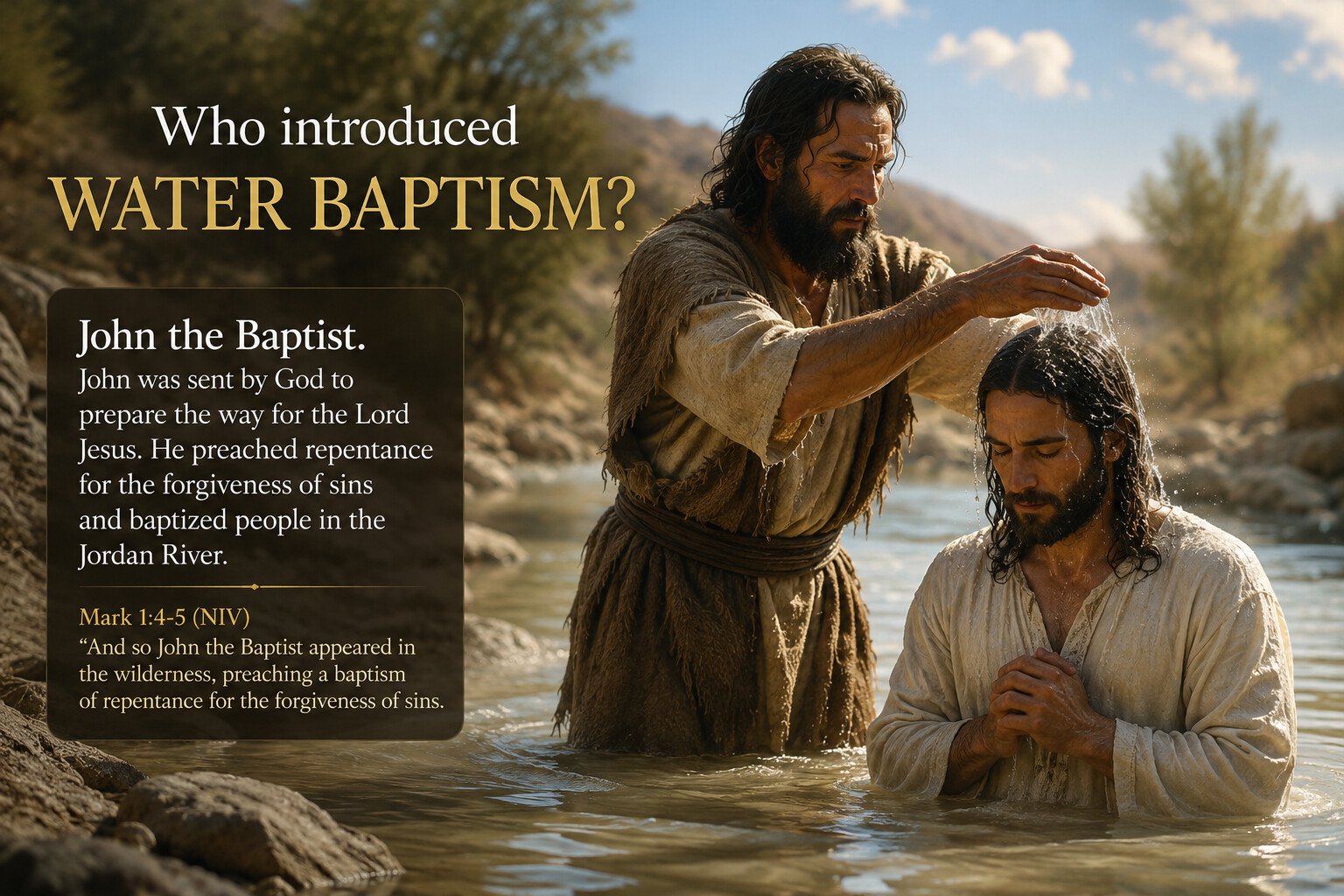
Although ritual washings existed among the Jews, water baptism as the public ministry associated with repentance and preparation for the coming Messiah became widely known through the ministry of John the Baptist, also called John the Baptizer. characteristic by which he was identified.
John carried out his ministry primarily at the Jordan River, where multitudes came to hear his preaching, confess their sins, and be baptized as means of preparing people for the coming Messiah.
The Scriptures record:
"John did baptize in the wilderness, and preach the baptism of repentance for the remission of sins." — Mark 1:4 (KJV)
Matthew likewise records:
"Then went out to him Jerusalem, and all Judaea, and all the region round about Jordan, And were baptized of him in Jordan, confessing their sins." — Matthew 3:5–6 (KJV)
What Was John's Primary Mission?
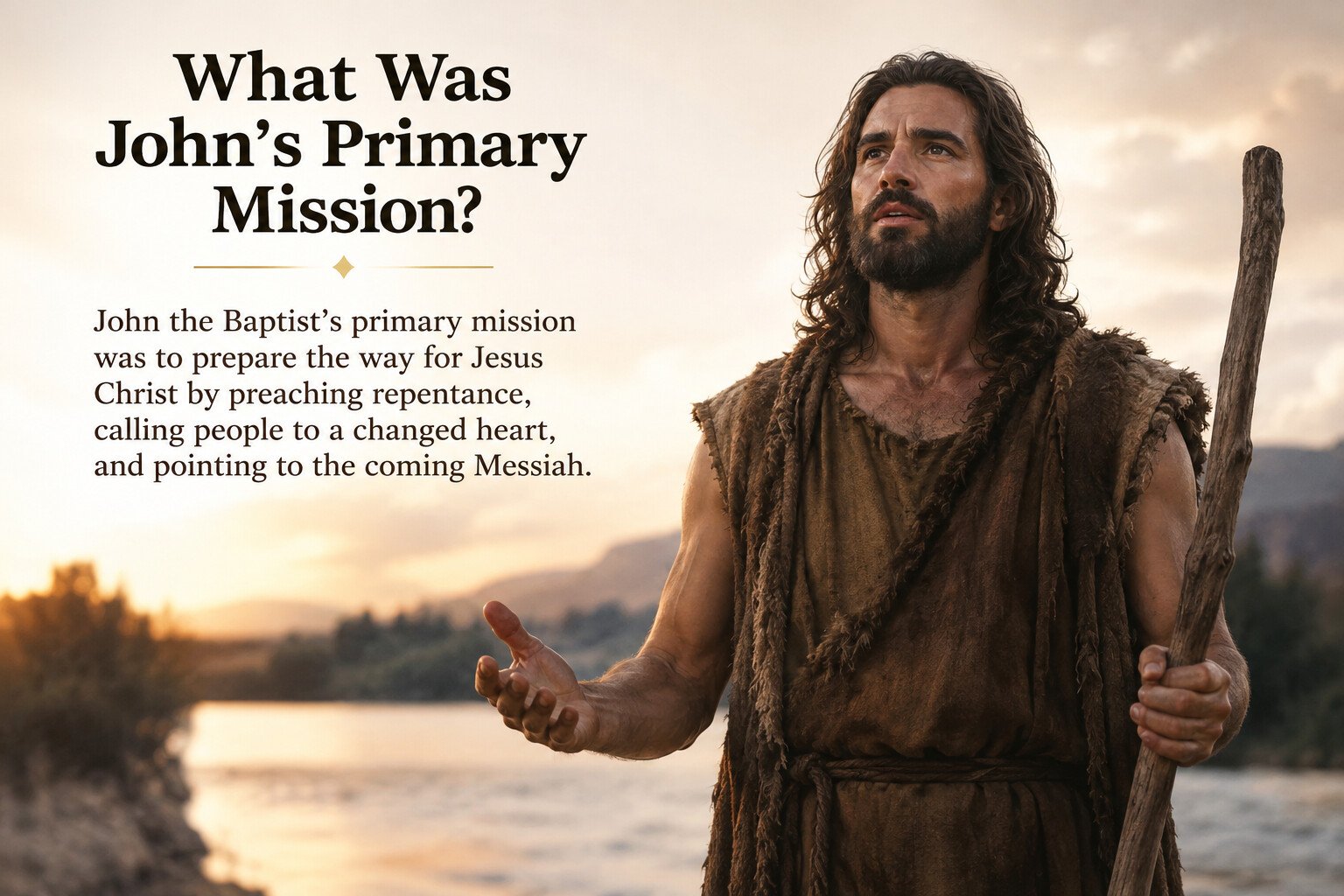
John's baptism was never intended to be an end in itself. Rather, it functioned as a symbol, pointing people toward the coming work of Jesus Christ.
A symbol represents a reality beyond itself. It communicates a greater truth that is yet to be fully revealed. In everyday language, a symbol is understood as a sign that represents something else. In the same way, John's baptism visibly pointed to the coming Messiah while simultaneously directing people's attention toward the coming Messiah.
His ministry was essentially announcing:
"Prepare yourselves, because the promised Savior is coming."
This perfectly fulfilled Isaiah's prophecy:
"The voice of one crying in the wilderness, Prepare ye the way of the Lord, make his paths straight." — Isaiah 40:3 (KJV)
Matthew confirms that John fulfilled this prophecy:
"For this is he that was spoken of by the prophet Esaias, saying, The voice of one crying in the wilderness, Prepare ye the way of the Lord, make his paths straight." — Matthew 3:3 (KJV)
John's baptism was therefore a prophetic signpost directing Israel toward Jesus Christ. As John's ministry grew, many began wondering whether he himself was the promised Christ.
Luke records:
"As the people were in expectation, and all were questioning in their hearts concerning John, whether he might be the Christ, John answered them all, saying, 'I baptize you with water, but he who is mightier than I is coming... He will baptize you with the Holy Spirit and fire.'" — Luke 3:15–16 (ESV)
This passage reveals one of the most important truths concerning water baptism. John deliberately distinguished his baptism from Christ's baptism.
John declared,
"I baptize you with water..."
But immediately followed with,
"...BUT he shall baptize you with the Holy Ghost and with fire."
This contrast was intentional. John wanted everyone to understand that his ministry was never the final destination, it was only the preparation.
His baptism pointed beyond itself to Someone infinitely greater. If John baptized with water, then Christ's baptism would not merely be another water ceremony. Instead, the Messiah would baptize believers with the Holy Spirit, inaugurating a new covenant reality.
John's ministry therefore served as a bridge between the Old Covenant expectation and the New Covenant fulfillment. John intentionally distinguished his ministry from Christ's ministry. His baptism pointed forward to Someone greater than himself. While John administered an outward sign using water, Christ would accomplish an inward spiritual work through the Holy Spirit.
This distinction demonstrates that John's baptism and Christ's baptism were not identical in purpose or nature. John himself openly acknowledged that his ministry was temporary. His assignment was never to establish a permanent system of salvation. Instead, his responsibility was to prepare hearts for Christ.
Jesus later testified concerning John:
"For this is he, of whom it is written, Behold, I send my messenger before thy face, which shall prepare thy way before thee." — Matthew 11:10 (KJV)
John's baptism belonged to this ministry of preparation. It awakened people to repentance and directed their faith toward the One who would accomplish complete redemption.
John called Israel to repentance because the promised Messiah was about to appear. His baptism publicly demonstrated a person's repentance and readiness to receive the One whom God had promised. It was therefore preparatory, not final.
John's baptism functioned as a symbol. A symbol is something visible that represents a greater invisible reality. It points beyond itself to something more significant.
In the same way that road signs direct travelers toward their destination without being the destination themselves, John's baptism directed people toward Christ without being Christ's saving work itself.
His ministry prepared people for the One who would accomplish what water alone could never accomplish.
John himself declared:
"I myself did not know Him, but for this purpose I came baptizing with water, that He might be revealed to Israel." — John 1:31 (ESV)
This verse reveals John's central mission. Water baptism was one of God's appointed means of introducing and revealing the Messiah to Israel
Why Was Jesus Baptized?
If John's baptism was a baptism of repentance, why did Jesus Christ submit to it when He had no sin to repent of?
The Apostle Paul affirmed what John the Baptist himself had already declared: John's baptism was a baptism of repentance.
"John indeed baptized with a baptism of repentance, saying to the people that they should believe on Him who would come after him, that is, on Christ Jesus." (Acts 19:4, NKJV)
Likewise, John openly proclaimed:
"I indeed baptize you with water unto repentance..." (Matthew 3:11, NKJV)
These passages leave no doubt about the purpose of John's baptism, it was designed to call sinners to repentance in preparation for the coming Messiah.
This gives rise to one of the most profound questions in Scripture:
If John's baptism was a baptism of repentance, why did Jesus Christ submit to it when He had no sin to repent of?
The Bible is equally clear that Jesus was completely without sin.
"For we do not have a High Priest who cannot sympathize with our weaknesses, but was in all points tempted as we are, yet without sin." (Hebrews 4:15, NKJV)
"Who committed no sin, nor was deceit found in His mouth." (1 Peter 2:22, NKJV)
If Jesus never sinned, then His baptism could not have been an act of personal repentance. This means His baptism served a purpose far greater than the forgiveness of sins. It invites us to look beyond the surface and ask what God intended to reveal through this remarkable event.
Matthew records that John initially refused to baptize Jesus.
"John would have prevented Him, saying, 'I need to be baptized by You, and do You come to me?'" — Matthew 3:14 (ESV)
John recognized Jesus' sinlessness and understood that Christ had no need for repentance.
However, Jesus answered:
"Let it be so now, for thus it is fitting for us to fulfill all righteousness." — Matthew 3:15 (ESV)
Notice carefully that Jesus did not say He needed repentance. Instead, He explained that His baptism was necessary to fulfill all righteousness. And upon hearing these words, John immediately consented and baptized Him.

The phrase "to fulfill all righteousness" does not suggest that Jesus needed cleansing from sin. Rather, it means that Jesus willingly submitted Himself to the Father's perfect will and faithfully fulfilled everything God had ordained concerning the Messiah.
Throughout Scripture, God's righteousness is expressed through His perfectly righteous character, His purposes, and His revealed will. Therefore, to fulfill all righteousness is to carry out completely what God had planned and revealed through the Law, the Prophets, and the Scriptures concerning His Son.
Jesus' baptism was therefore an act of complete obedience to God's eternal purpose, not an act of repentance.Thus, the baptism of Jesus is not a contradiction to the purpose of John's baptism, it is the divine fulfillment of a much greater purpose that God intended to reveal to the world. This realization marks the beginning of a deeper understanding of one of the most significant events in the life and ministry of Jesus Christ.
Understanding why Jesus was baptized is essential because it unlocks the deeper significance of His ministry and God's redemptive plan. As we examine the Scriptures, we discover that Jesus' baptism was not about repentance but about fulfilling all righteousness.
The full significance of this statement will be explored in Lesson Two, where we shall carefully examine why Jesus was baptized and what His baptism reveals about God's plan of redemption.
The foundation laid in this lesson prepares us to examine the next crucial question:
Why did the sinless Son of God insist on being baptized by John?
That question forms the focus of Lesson Two
Lesson Summary
This lesson has established that water baptism did not originate as a means of salvation but as part of John's prophetic ministry to prepare Israel for the coming Messiah. John's baptism was a baptism of repentance, serving as a visible sign that pointed people toward Jesus Christ. John clearly distinguished his baptism with water from Christ's greater baptism with the Holy Spirit, showing that the two ministries were different in purpose. Finally, we introduced the important question of why Jesus, though completely sinless, submitted to John's baptism—a question whose full biblical answer will be explored in the next lesson.
Looking Ahead
Lesson Two: Why Was Jesus Baptized? — Understanding the Meaning of "To Fulfill All Righteousness."
In the next lesson, we will examine why the sinless Son of God insisted on being baptized by John and how His baptism perfectly fulfilled the Father's eternal purpose as revealed throughout the Scriptures.